0→1 SaaS ProductNFC + WebB2B2C · PhygitalLive Product
Me Online
Designing a phygital identity platform for modern multi-role professionals — where one tap replaces a stack of business cards.
01 — Overview
A platform designed to solve identity fragmentation
Not an NFC business card app. A phygital identity-sharing platform engineered for context-aware professional networking.
The modern professional no longer has one identity. They are simultaneously a founder, a consultant, a board member, and a mentor. Traditional business cards — designed for a single-role world — collapse under this complexity.
Me Online bridges physical networking ritual with dynamic digital intelligence. One reusable NFC-powered smart card, connected to a live multi-profile web ecosystem — capable of representing any professional identity, in any context, through a single tap.
02 — Problem Space
The real issue was never the business card
Visible symptoms pointed inward — the root cause was professional identity fragmentation, not printing logistics.
Core Problem Statement
Traditional business cards force a fixed, single-context identity onto professionals who operate simultaneously across multiple roles, industries, and relationship contexts.
⊞
Multiple Cards, Multiple Anxieties
Professionals carry 3–5 different cards — each representing a different role — creating physical overhead and cognitive anxiety.
⊘
The Wrong Card Problem
In the heat of a networking moment, users reach for a card and hand over the wrong one.
⊙
Information Decay
Phone numbers change. Roles evolve. Static printed cards become obsolete within weeks, forcing expensive reprinting cycles.
◎
Identity Compression
A 90mm × 54mm card cannot hold the richness of a modern professional's multi-dimensional identity.
03 — Research & Discovery
Understanding the professional networking ritual
Qualitative behavioral observation combined with secondary market and sustainability analysis.
Primary · 1
User Interviews
In-depth sessions with multi-role professionals — founders, consultants, association members across Chennai & Bangalore.
Primary · 2
Networking Behavior Observation
Direct observation at professional events — card exchange rituals, hesitation patterns, post-exchange follow-up behaviors.
Primary · 3
Context Mapping
Mapping the emotional and environmental context in which business card exchanges happen.
Primary · 4
Pattern Analysis
Identifying recurring behaviors and workarounds that users invented to manage identity complexity.
10B+
Business cards printed globally per year
88%
Cards discarded within one week of receipt
+16%
Higher follow-up conversion with digital cards
↑NFC
Adoption accelerated by UPI & contactless
04 — Core Insights
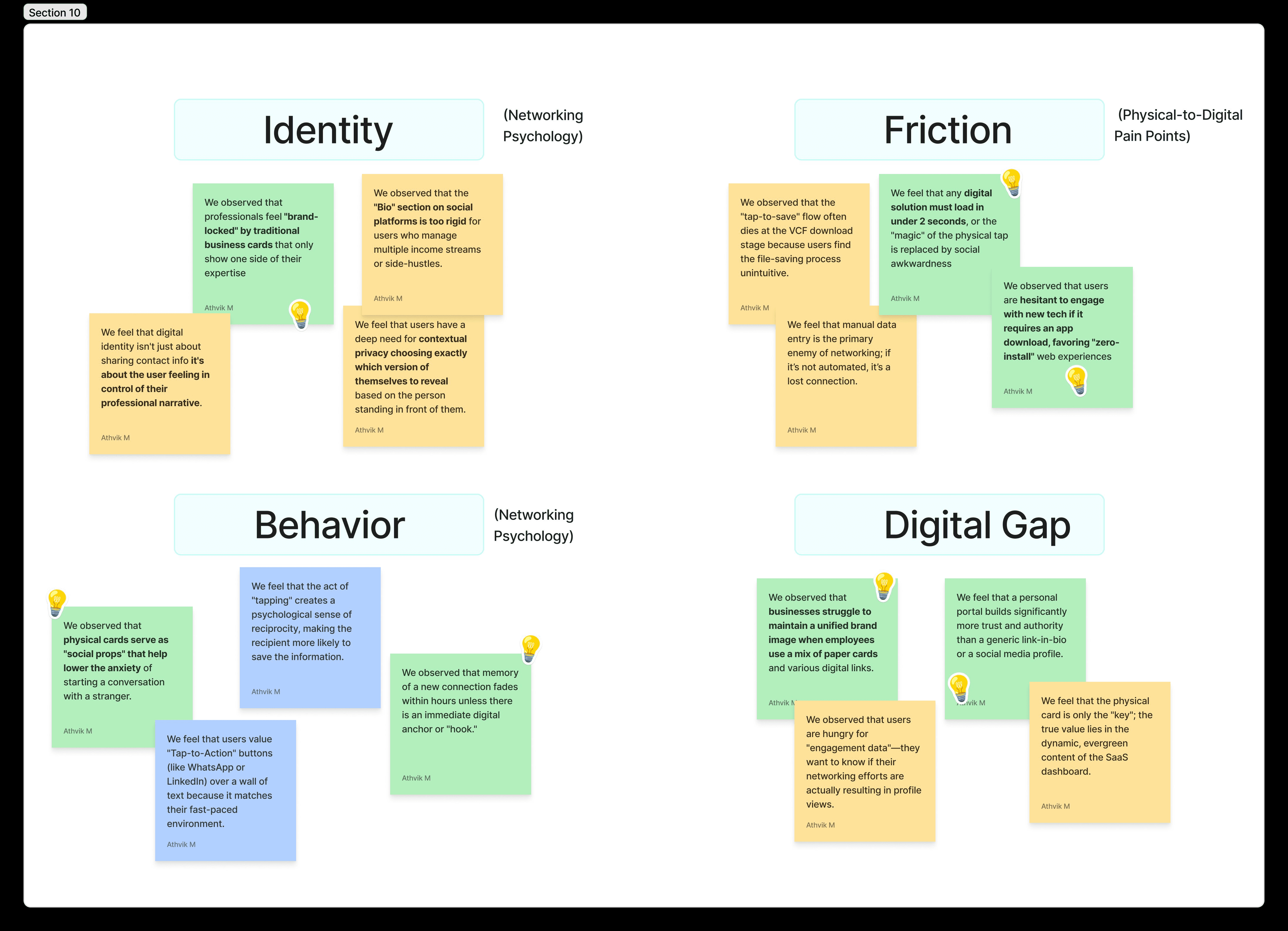
What the research actually revealed
Four signal insights that shaped the entire product strategy — beyond surface-level observations.
Insight 01
"Business cards are identity signals — not just information carriers. The physical card communicates status, taste, and seriousness before a single word is read."
Insight 02 — The Adaptation Pattern
"Users don't solve identity fragmentation — they adapt around it. Carrying stacks of cards, writing corrections — these are coping behaviors, not solutions."
Insight 03 — Contextual Identity
"Professional identity is not fixed — it is contextual. The same person needs to present differently to an investor, a client, an association peer, and a potential collaborator."
Insight 04 — The Digital-Only Failure Mode
"Digital-only alternatives fail precisely when they're needed most — during live networking moments. Delayed app opens destroy networking momentum."
05 — Target Users
Designing for the multi-role professional
Professionals aged 30–60 simultaneously operating across multiple roles — founders, consultants, corporate leaders, high-volume networkers.

Arjun S.
38 · Chennai
Founder · Consultant · Mentor
Goals
→ Share right identity in every context
→ Eliminate card-switching anxiety
→ Make premium first impression
Pain Points
× Carries 4 different cards daily
× Handed wrong card 3× last month

Priya M.
44 · Bangalore
VP Operations · Assoc. Head · Speaker
Goals
→ Represent both corporate + association roles
→ Faster follow-up after events
→ Update details without reprinting
Pain Points
× Reprinted cards 3× in 2 years
× Association contacts use wrong email

Vikram R.
52 · Chennai
Sales Director · Investor · Board Member
Goals
→ Instant contact save for high-volume networking
→ Switch identity by context
→ Premium card that reflects seniority
Pain Points
× Loses connections — no follow-up
× Sales card shown to investor contact
06 — Competitive Landscape
The market was solving the wrong problem
Competitors built functional NFC sharing. None addressed identity representation — a fundamentally different product philosophy.
Platform
NFC
Multi-Profile
Identity Layer
Primary Focus
Popl
✓
✗
✗
Contact sharing + CRM
Blinq
✓
✗
✗
Digital card aesthetics
Mobilo
✓
✗
✗
Lead capture + CRM
Linq
✓
Partial
✗
Social + content links
V1CE
✓
✗
✗
Premium card aesthetics
Me Online
✓
✓
✓
Identity representation
07 — Product Strategy
Evolving behavior, not replacing it
Preserve the traditional ritual of physical networking. Enhance it with digital intelligence. Never break the moment.
Digital-Only Fails Because
× Breaks real-time interaction flow
× Delayed follow-up dependency
× Removes the physical memory anchor
× Signals lower status in premium contexts
Phygital Succeeds Because
✓ Preserves the physical exchange ritual
✓ Instant interaction — no app required
✓ Premium physical object = premium impression
✓ Dynamic backend = always-current identity
SCAMPER Ideation Framework
S
Substitute
Replace static printed information with a dynamic, live identity layer that updates in real time.
C
Combine
Merge the physical card, NFC chip, SaaS platform, and multi-profile networking into a unified system.
A
Adapt
Adapt the already-familiar tap-to-transact behavior (UPI, contactless pay) into tap-to-network.
M
Modify
Transform the card exchange ritual from information handoff into a full identity experience moment.
P
Put to New Use
The card becomes an identity platform, networking accelerator, and multimedia gateway.
E
Eliminate
Eliminate manual typing, multiple cards, delayed follow-up, reprinting cycles, and wrong-card anxiety.
R
Reverse
Instead of physical card → static info: physical trigger → dynamic identity experience.
08 — User Flow
Designing for the first 3 seconds
The entire UX was architected around one critical window — the moment after a tap. Identity clarity, trust, and networking momentum are decided in 3 seconds.
"Enable instant, context-aware identity sharing with minimal interaction friction. The first 3 seconds after tap determine whether networking momentum is created or lost."
Single NFC Card
Professional carries one reusable physical object — replacing a stack of multiple role-specific cards.
Networking Moment
Investor meeting, industry event, client introduction, or casual professional encounter.
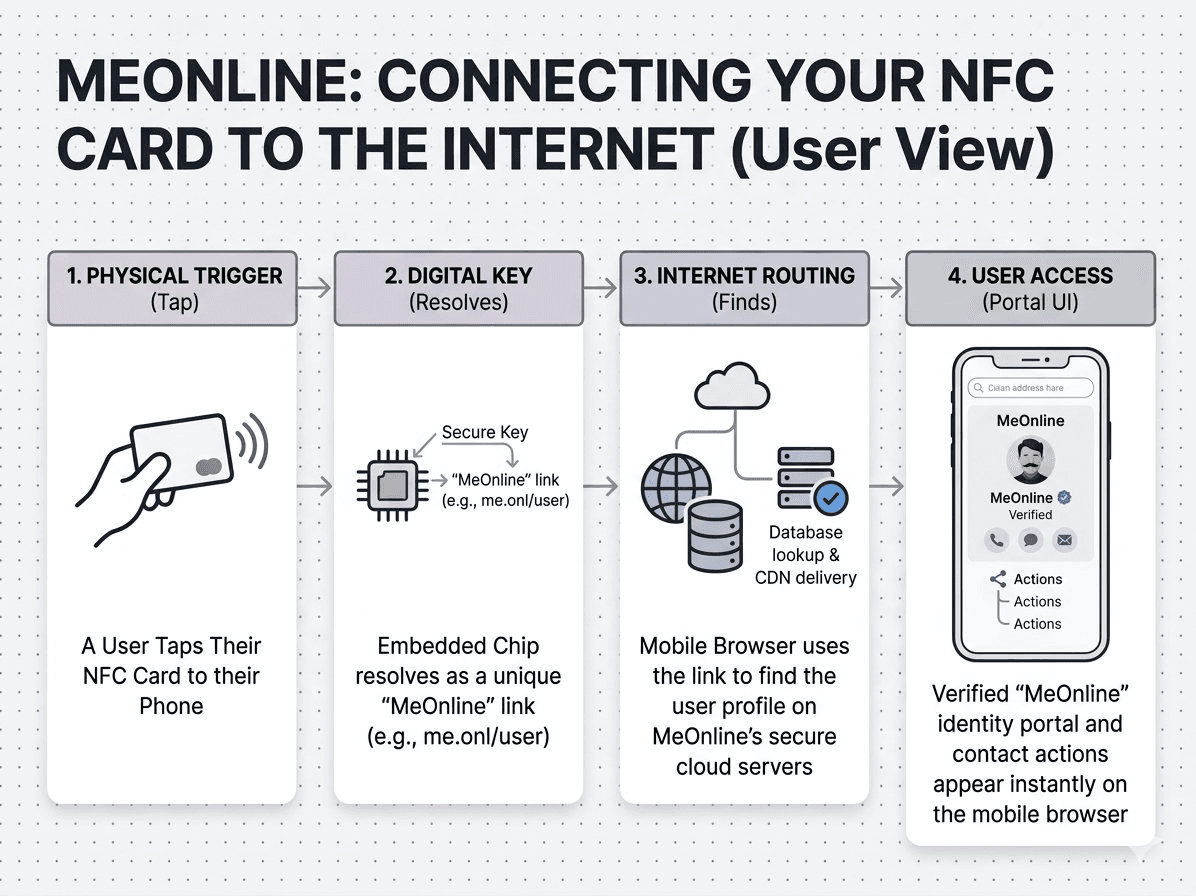
Tap on Receiver's Phone
Single tap, zero friction, no app required on the receiver's end.
NFC Fires Unique URL
Chip NDEF record triggers a secure, personalized link that opens automatically in the phone browser.
Me Online Portal Opens
Instant identity overview, sub-second load, zero login required for the receiver.
Identity Overview Displayed
Professional name, photo, headline immediately visible above the fold.
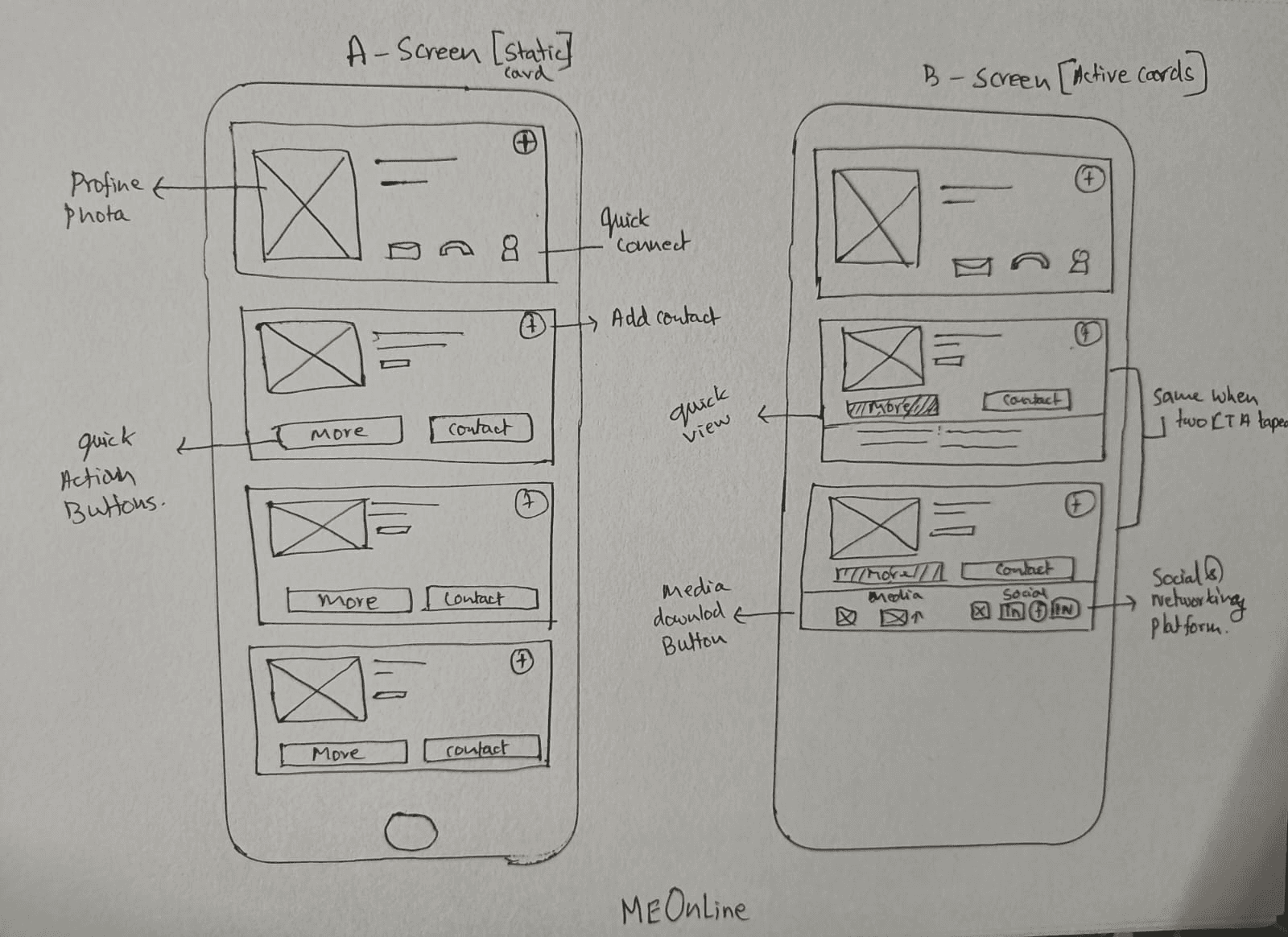
Multi-Profile Cards Shown
All professional identities visible, scannable, contextually clear in a scrollable layout.
Receiver Explores Profiles
Discovers full identity breadth, relevant context, supporting materials.
Instant Action Layer
Save Contact / WhatsApp / Call / LinkedIn / Website — networking completed in one tap.
09 — Design Rationale
Every decision had a reason
Key UX decisions were behavioral design responses to networking context — not aesthetic preferences.
UX Decision 01
Scroll-Based Multi-Profile Layout
Matches mobile native mental models. Enables fast vertical scanning without navigation switches.
UX Decision 02
Show All Profiles, Don't Force Selection
Forced profile selection creates a decision barrier. Showing all profiles enables contextual discovery.
UX Decision 03
Action-First Networking Layer
WhatsApp, Call, Save Contact, and LinkedIn are surfaced as primary CTAs — above detailed content.
UX Decision 04
QR Fallback as Standard Feature
Not all devices handle NFC consistently. QR provides a universal fallback that maintains the same interaction quality.
10 — Architecture
The technical phygital stack
Functional architecture bridging physical hardware with cloud SaaS infrastructure in a seamless interaction chain.
P
NFC Smart Card — Physical Layer
PVC Marble or Metal Engraved card with embedded NFC chip. Works with all modern smartphones — no app required on the receiver's device.
N
NFC Trigger — Interaction Layer
Phone NFC reader activates on proximity. Reads chip NDEF record. Fires unique personalized URL. Browser opens without app.
C
Cloud SaaS Backend — Data Layer
Hosted platform fetches real-time profile data. Multi-profile schema supports unlimited identity contexts per user.
U
Dynamic Interface — UX Layer
Mobile-first web portal renders identity overview → multi-profile cards → multimedia assets → contact action layer.
A
Action Layer — Conversion Layer
Save Contact (vCard), WhatsApp direct, Phone call, LinkedIn profile, Website — all instantly accessible.
11 — Brand & Design System
Building a brand that commands presence
Premium physical quality and modern digital intelligence — simultaneously.
Brand Goal
Confident
You own the room
Brand Goal
Unique
No one else has this
Brand Goal
Clear
Immediately understood
Brand Goal
In Control
Your identity, your rules
12 — Physical Product
The card that carries an entire identity
Every material, texture, and finish decision was a brand and UX decision — not a manufacturing one.
Variant 01
PVC Marble Finish
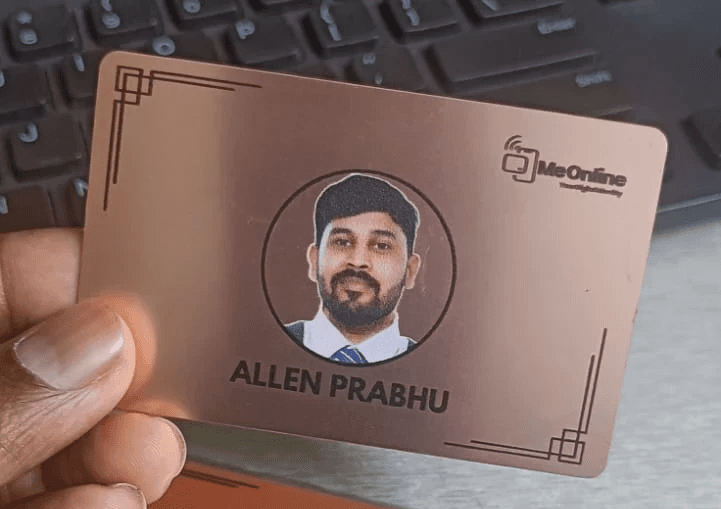
Premium marbled PVC substrate. Laser printed front. Gloss or matte finish. NFC chip embedded flush on reverse. Lightweight, durable, distinctive.
Variant 02 — Premium
Metal Engraved
Brushed stainless steel with laser-engraved identity details. NFC chip embedded in card body. Heavyweight, executive feel.
13 — Screens
A digital identity portal designed for instant comprehension
Speed of comprehension was the primary design metric. Maximum identity clarity in the first viewport.
× Before — Traditional Card
× Carry 5 different business cards
× Guess which card to hand over
× Hand wrong card — embarrassment
× Verbally correct the mistake
× Card discarded within a week
× No follow-up — lost connection
✓ After — Me Online
✓ Carry 1 NFC smart card
✓ Tap card on phone — instant
✓ All profiles shown instantly
✓ Receiver picks relevant profile
✓ Contact saved instantly to phone
✓ WhatsApp / LinkedIn — one tap
14 — Challenges & Solutions
Every constraint became a design decision
Three core design challenges that shaped the final system architecture and interaction design.
Challenge 01 — Problem
Too Many Profiles = Visual Chaos. A professional with 5+ distinct identities creates an overwhelming interface without structure.
Solution
Visual grouping + card hierarchy + role-based categorization enabling 2-second scanning without cognitive load.
Challenge 02 — Problem
NFC Awareness Gap. Despite smartphone NFC ubiquity, many users weren't immediately aware of tap-to-open behavior.
Solution
QR code as permanent fallback on every card. Clear embossed NFC indicator with 'Tap Here' instruction.
Challenge 03 — Problem
Performance on Mobile Networks. The portal loads in a live networking moment — on a stranger's phone, under social pressure.
Solution
Lightweight frontend architecture. Identity overview visible before full page load. Critical information renders in under 1.5 seconds on 4G.
15 — Go-to-Market
When a new behavior needs education
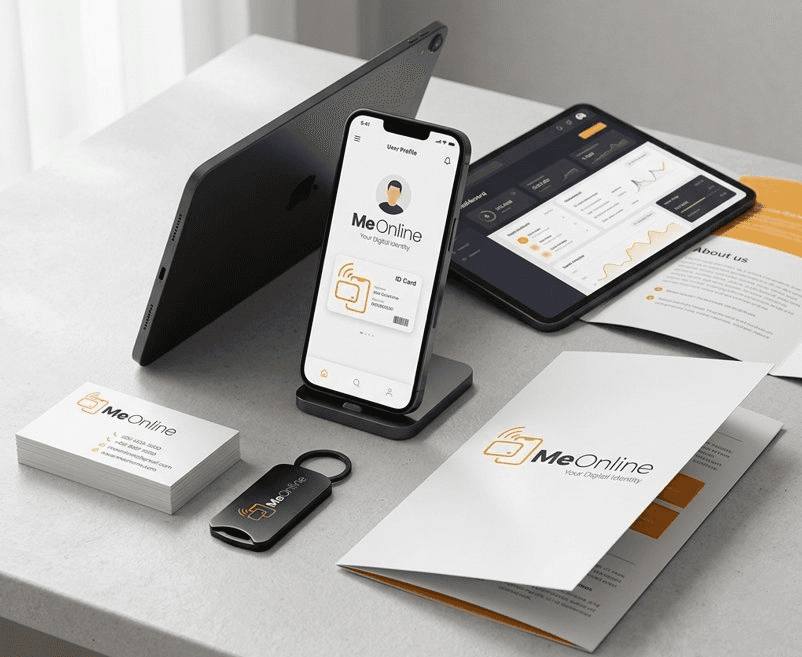
Introducing a phygital interaction pattern required a complete go-to-market design system — not just a product launch.
"When introducing a new interaction behavior, education becomes part of the UX. The brochure, the demo event, the onboarding email — these are product touchpoints, not marketing."
16 — Impact & Outcomes
From friction to one tap
Research-backed indicators and behavioral design projections grounded in industry data.
~90%
Reduction in reprinting costs for active users
Research-backed indicator
Real-time
Profile updates live across all tap interactions instantly
Platform capability
1 Tap
Full identity delivery — replacing a multi-step manual process
Interaction design outcome
<3s
Identity comprehension window achieved through UX architecture
UX design target
Zero
Wrong-card scenarios — contextual identity always accessible
Behavioral design outcome
∞
Professional identities manageable from one physical card
Multi-profile capability
Behavioral Outcomes ↑
↑ Identity clarity for the receiver
↑ User confidence in networking moments
↑ Faster networking engagement velocity
↑ Professional impression quality
Behavioral Outcomes ↓
↓ Cognitive load in networking decisions
↓ Networking friction and hesitation
↓ Physical card waste and reprinting
↓ Time-to-connect: minutes → seconds
17 — SWOT Analysis
Where we stand in the landscape
S — Strengths
· Unique phygital interaction model
· Multi-profile identity architecture
· Premium physical product positioning
· Zero friction for the receiver
· Reusable, scalable SaaS infrastructure
· NFC + QR dual-channel approach
W — Weaknesses
· NFC awareness education required
· Smartphone compatibility dependency
· Physical product logistics overhead
· Premium pricing vs free alternatives
O — Opportunities
· India's fast-growing startup ecosystem
· Professional networking events & expos
· Premium corporate gifting market
· NFC familiarity growing via UPI adoption
· B2B team deployment at enterprise scale
T — Threats
· Growing NFC competitor platforms
· QR-only alternatives at lower price
· Behavior resistance in traditional sectors
· Commoditization of NFC cards
18 — Closing Note
What this project taught me
Designing a live phygital product in one month — solo — across every design dimension compressed a full product lifecycle into a single sprint.
01
The behavioral layer is the product
NFC technology was available before Me Online. The product value wasn't in the chip — it was in understanding why professionals struggle with identity fragmentation and designing a system that evolves their existing behavior.
02
Phygital design requires multi-discipline thinking
Material selection, NFC chip placement, print finish choices — these were UX decisions, not manufacturing decisions. A gloss card reflects light in a handshake context.
03
Education is a UX responsibility
When a product introduces new interaction behavior, every promotional material, event demo, and onboarding screen is a UX touchpoint. The GTM strategy was as much a UX problem as the portal design itself.